Mental health is not just about statistics, diagnoses, or the ability to work or study. It is about people’s lived experiences, their lives, and their needs—all of which should be taken into account in decision-making.
There is a wealth of research data on mental health. This includes statistics, information from the service system, and the expertise of professionals. These form an important part of society’s knowledge base and guide the prevention and treatment of mental health problems. However, mental health is also a person’s own lived experience, through which an understanding is built of how life, well-being, and stress feel to the individual. Yet the importance of experiential knowledge is often overlooked. Categorization, research data, and effectiveness are important for the system to function properly. However, when addressing human issues, we cannot overlook the individual. The theme of World Mental Health Day, “Lived experiences heard: real voices, real change,” reminds us that lived experience is not the opposite of research data or professional expertise. It complements these by explaining how services and decisions affect what they are ultimately intended to achieve: people’s mental health and well-being. Even compared to other Nordic countries, the Finnish healthcare system is very issue-oriented rather than people-centered. If a person recovering from mental health issues feels they are being treated as a problem to be solved rather than as a human being, how does this affect their sense of self-worth and their perceived ability to recover? This technical perspective is evident, for example, in how mental health and the need for assistance are assessed based on a person’s ability to work or study. If a person is able, with their last ounce of strength, to fulfill their obligations and meet society’s expectations, their silent suffering and the effects of their symptoms on other areas of life outside of work or school remain invisible. Only when a person’s overall well-being collapses does their suffering become visible to others. Thus, suffering becomes apparent only when it affects a person’s productivity. Mental health should be valued in and of itself, not merely as a prerequisite for productivity. A person’s well-being matters even when they are able to go to work, study, and fulfill their responsibilities.
Seeking help is made difficult by a culture in which burnout has become commonplace and overcrowded services are the norm. Do you feel it’s okay to seek help yourself and put even more strain on the system when it seems like everyone else is struggling too? The ideal of going it alone can create problems and lead people to resort to unhealthy coping mechanisms. That is why people should have sufficient opportunities to address difficult issues and receive support before a situation escalates. In order for people to share their experiences and feel seen, we need safe communities where they can ask for help without fear of being stigmatized. It is also important to realize that you do not have to cope with difficult situations on your own. The ability to influence your own life and the decisions that affect you is likewise an important part of well-being. Civil society and organizations play a significant role here—they provide support and communities, and bring people’s experiences into the public discourse. The government seems to place its trust in the welfare state to solve mental health problems, but how can we expect the welfare state to function when its responsibilities are being expanded at the same time that the conditions for its operation are being undermined?
Citizens’ distress, loneliness, and feelings of exclusion are not merely domestic political issues. Given the current security policy landscape, society’s resilience to crises should also be examined from the perspective of well-being. The ability to weather crises does not depend solely on defense or the operational capacity of public authorities. It is also influenced by people’s trust in society, their sense of inclusion, the support provided by communities, and the ability to receive timely assistance. Throughout history, volunteer work coordinated by organizations has been an essential part of Finnish crisis resilience. The ability to weather crises does not depend solely on defense or the operational capacity of public authorities. It is also influenced by people’s trust in society, their sense of inclusion, the support provided by communities, and the ability to receive timely assistance. Throughout history, volunteer work coordinated by organizations has been an essential part of Finnish crisis resilience. Experiences must be allowed to influence services, structures, and decisions. This requires a society where people have safe spaces to share their experiences and where stakeholders incorporate these experiences into public discourse and decision-making. To ensure that everyone’s voice is heard, we must maintain structures that provide the space for it.
more information
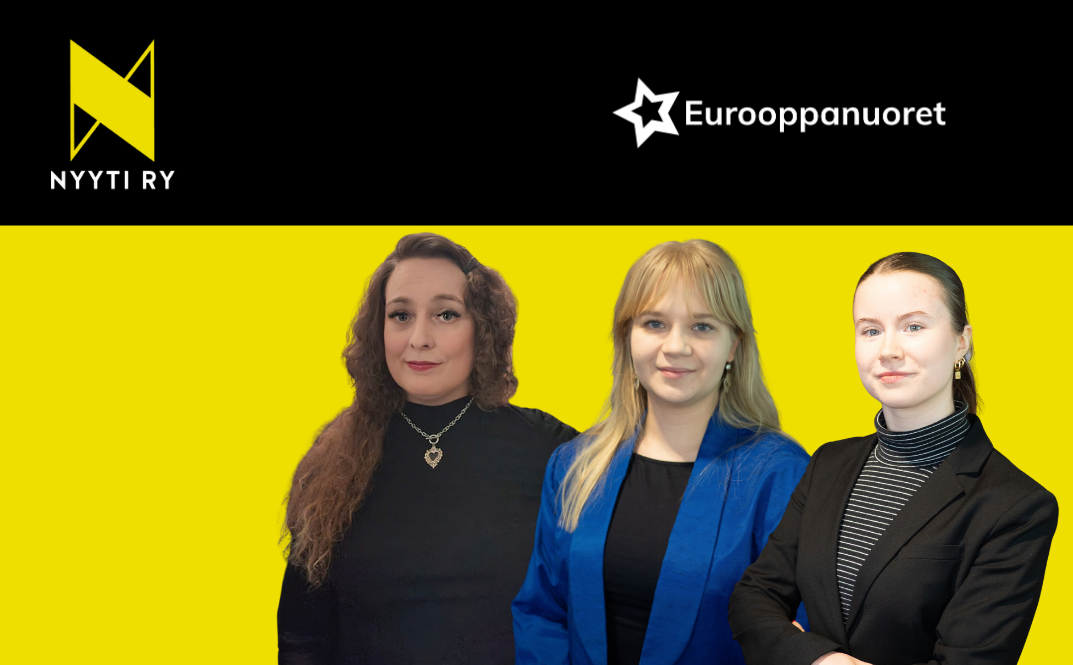
Sanja Laitinen-Lindelöf
Chair, Nyyti ry
Pieta Päivänen
President, JEF Finland