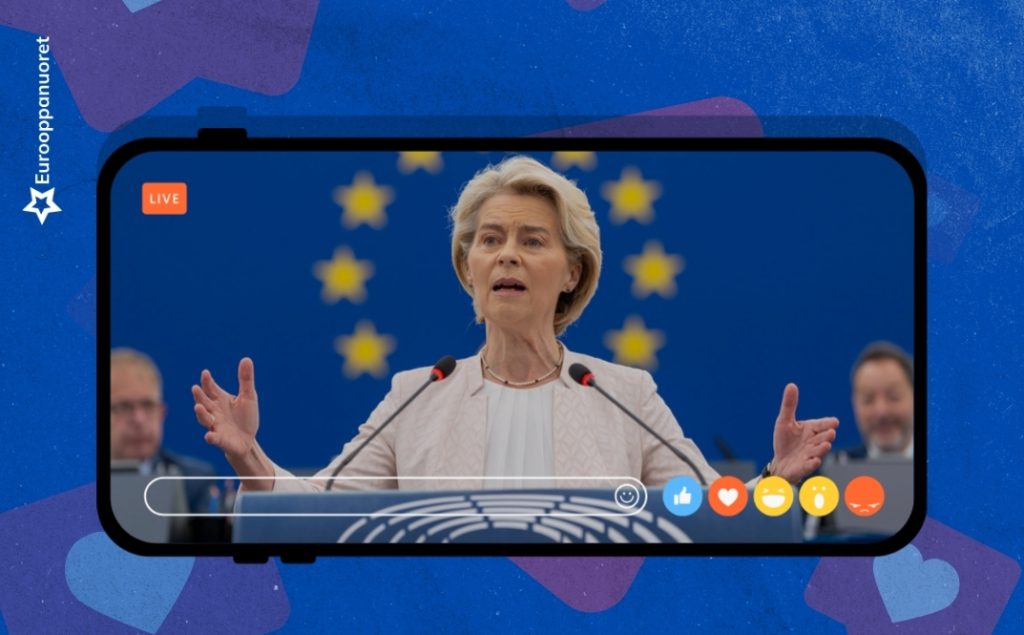
JEF Finland believes in a future federal state and a Europe where solutions to the great challenges of our time are found through cooperation, without breaching the principle of subsidiarity. The core purpose of the federal model is to distribute power across different levels according to where decision-making is most democratic and effective. So why does the debate on federalism keep collapsing, time and again, into strawmen and oversimplifications?
A federal model does not automatically mean weakening the influence of national parliaments. On the contrary, a federal model could preserve parliamentary autonomy at the regional level. For JEF Finland, it is important to keep decision-making close to people. It is also paradoxical to think that expanding the European Parliament’s powers would “reduce” the influence of small countries. Institutional reform could in fact correct the Union’s democratic deficit and potentially improve the position of small states.
Critics of federalism criticise European Union decisions that are supposedly “against Finland’s national interest.” However, the nature restoration regulation and packaging regulation mentioned are still works in progress. The EU is not a monster trampling small countries, but a slow and precise legislative framework. That is why union-wide decisions take time and are, at their best, compromises. Finnish parliamentarians, ministers and civil servants are involved in legislation, but not enough of them. Finland’s influence in the EU should be increased, which is achieved by communicating the various opportunities and through openness — not by clinging to old-fashioned nation-state thinking, which makes the EU feel like a negative bureaucratic machine that is “somewhere over there in Europe.”
Complete debt denialism leads to the Union’s inability to develop its competitiveness. Economic interdependencies are also changing the dynamics of state aid. Finland is not competing against giants, but alongside them. The economic growth of large member states also benefits the smallest ones, as it at its best increases the volume of financial flows within the single market.
The historic joint debt taken on during the COVID-19 pandemic is not perfect, but it was necessary. The facilitation of debt arrangements must be developed further in future, both in terms of financial oversight and conditions. The global economy has shifted in a direction where the United States and China have harnessed central bank financing as a competitive tool. Europe, and Finland in particular, must reconsider its relationship with debt.
The ideal of Finland as a country that throws itself into being a difficult opportunist is unsustainable. It is important that every member state’s voice is heard and taken into account in decision-making. That does not mean, however, that we should not bend towards cooperation and, at times, painful compromises. The Union is a coalition of 27 member states, whose decisions affect over 450 million EU citizens. Finland must not ruin its reputation — it is far better to be a cooperative model student than a new, snarling Hungary. Acting as a model student has also preserved Finland’s reputation and offered more opportunities to influence matters behind the scenes, which is why it should not be ruined over just a few compromises.
But instead of centralising power, should Finland instead promote institutional reform and fixing the structural flaws of the economic system? What if, however, the latter two could be fixed through deeper integration? Treaty reform is essential so that the Union has a legally sturdier basis for its operations, along with a renewed mandate from member states — and this too would advance integration, not the opposite. At the same time, fiscal rules could be updated to better match today’s debt-driven operating environment. Institutional reforms must take into account the balance between the different institutions. The European Parliament should have stronger powers commensurate with its mandate. For example, a right of legislative initiative for Parliament would be an important reform. The Commission’s power to sanction member states for breaches should also be strengthened. This could mean, for example, the conditional freezing of funding. The power of the Councils would not inevitably shrink as integration deepens — their scope could also be expanded at the regional level.
Finland’s and the EU’s interests go hand in hand. That is why it doesn’t pay to bite that hand.
For more information:
Nea Baarman
President