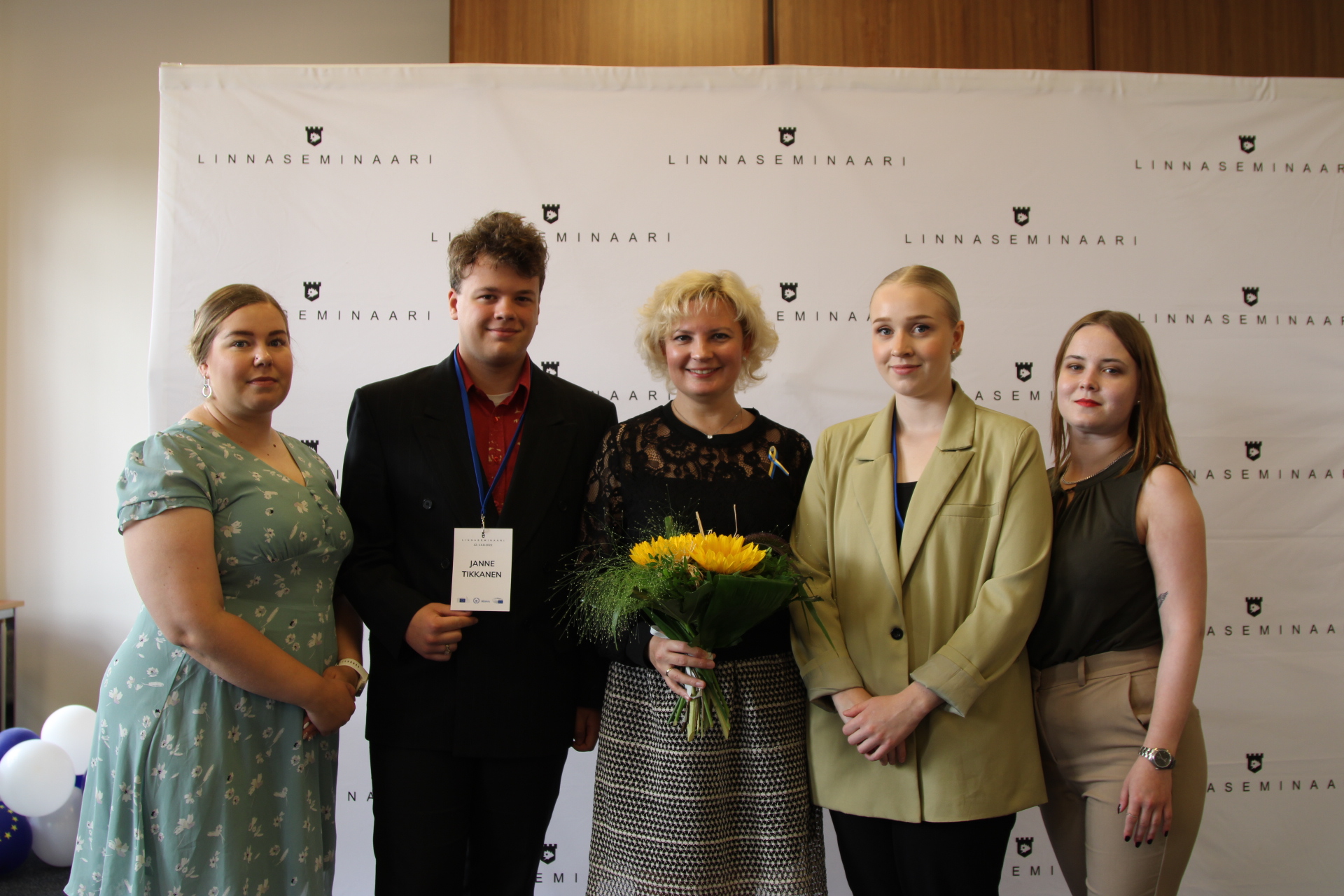
The Linnaseminaari has been organised for a long time, and now for the first time since the pandemic. This was the first Linnaseminaari I have attended. The speakers were absolutely brilliant and the seminar exceeded my expectations, which were already quite high. I was very much looking forward to meeting Jutta Urpilainen and Aura Salla. Meeting the Ambassador of Ukraine was a great honour and her address was deeply moving. The seminar’s themes were well chosen and topical. There were talks related to the European Year of Youth as well as ones delving into climate change. The Greens’ MEP Ville Niinistö led us into the subject on the second day with his sharp speech.
Friday
Friday began with the opening of the Linnaseminaari and a speech by Jutta Urpilainen. Let me gush once more about how amazing it was to see her. She is one of those politicians who has stuck in my mind ever since I started following politics as a child. Next week I get to moderate one of the panels at the Europe Forum, where Urpilainen will also take part, so exchanging a few words did no harm. Urpilainen naturally spoke about matters related to young people’s participation — after all, the European Year of Youth is a major part of the Commission’s year 2022. She told us that 1.6 billion children have been out of education because of the pandemic. It is estimated that around 10 million children will not return to school even if coronavirus restrictions allowed a return to normal. In Latin America, for example, schools have been closed for almost two years. Instead of going to school, children may end up working, especially in poor rural areas. The absence of school in a child’s life also causes other adverse effects. These can include pregnancies among young girls and domestic violence.
Urpilainen spoke about the effects of the pandemic and the war on the functioning of the EU. The EU has navigated through crises and remained capable of action. According to Urpilainen, the EU has even grown stronger by working on a common front. The crises have pushed forward, for example, the deepening of the health and defence union. The crises have underlined the need for growing resilience and strategic autonomy. The Commission has, however, also determinedly implemented its political programme. Progress has been made, for example, in advancing the green and digital twin transition.
Saturday
Saturday began with speeches by Members of the European Parliament. First up was Henna Virkkunen with digitalisation as her topic. She began by explaining what digitalisation actually means. It is not just information technology, but using it to transform operations or to enable something new. Examples include various services and platforms, such as Uber, Google and Twitter. Digitalisation is something we want to harness, as it brings, for example, new business, more efficient healthcare, support for reaching climate targets, and more effective education. In practice, then, the benefits are enormous. Despite these, there are also downsides. For example, dependence on countries that hold raw materials is real. The European Union does not want to be deeply dependent on China, for instance. Efforts have been made to reduce dependence through investment and development within the European Union. The aim of the EU’s digitalisation strategy is to harness digitalisation to serve people and businesses. Europe’s goal of carbon neutrality will not be achieved without making use of digitalisation.
The second speaker on Saturday was Ville Niinistö. His sharp speech addressed, for example, cooperation between the EU and NATO and the division of labour in implementing security policy. The speech naturally also covered climate action. He reminded us that Finland’s climate policy relies heavily on the national implementation of EU decisions. The unfortunate fact is that by 2080 the average temperature of the planet will be three degrees higher than in pre-industrial times if the current climate trajectory continues. From the end of the 19th century to the present day the temperature has risen by 1.1 degrees, so the change is hard even to comprehend. It is now time to throw in the bin all dissenting voices or criticism of Finland’s climate targets, because there is room for improvement and ambition of our own is needed.
Saturday also included JEF Finland’s and JEF Europe’s programme and, of course, JEF Finland’s 25th anniversary celebrations. The day also had room for the final speakers, who appeared in the form of a panel discussion. The panel featured Nils Torvalds – MEP, Karoliina Niemi – Forest Director, forest industry, Tapani Veistola – Executive Director of the Finnish Association for Nature Conservation, and Riitta Röhn – environmental lawyer. Looking at the speakers, the panel naturally related to the forest industry. What emerged from the panel was that EU legislation must retain room for manoeuvre and flexibility. Forests differ from one another, and for Finland the forest sector is significant as a livelihood. In Finland, two thirds of the land area is forest and the forest industry consumes a quarter of Finland’s energy, so the scale is large.
Sunday
Sunday featured several wonderful speakers. I already mentioned earlier that I was greatly looking forward to meeting EU policy expert Aura Salla. I have long followed her work through social media, and it was fantastic to meet her in person. Aura was definitely the most captivating speaker of the weekend. She sat down on the stage in front of us and began chatting with us in a relaxed way. Her talk felt engaging, like it was told from one person to another. It covered important matters and was clearly delivered by a professional, yet it was extremely interesting and personal. Aura spoke, for example, about Meta’s operations in the EU and their future. According to her, Meta is not leaving Europe, but its operations may differ from those in America, for example. Consumers may therefore have different features available. Aura’s talk radiated her professionalism, her humanity and the broadening of her worldview as her professional identity has grown.
The other speaker was the wonderful Ambassador of Ukraine, Olga Dibrova. I was of course greatly looking forward to meeting her, as surely everyone was. She was welcomed with applause and a standing audience. The respect and solidarity towards her and Ukraine, and together with Ukraine, was palpable. The Ambassador reminded us, however, that the war will not be won with solidarity and sympathy. Ukraine needs concrete support — right now, weapons are needed most. Ukraine’s aim is to move the front line and push Russia back before winter arrives. This autumn, then, a critical battle for the country is being fought, and that of course requires a great deal of armed force.
The Linnaseminaari was brought to a close by docent and Europe researcher Timo Miettinen. He gave a lecture-style overview of the state of Europe and its future. In his overview he focused in particular on the last ten years. He began the overview with Europe’s internal crises. These have included the euro crisis: the economic, debt and banking crisis, the rise of populism and upheavals in the party field, the refugee crisis, and Brexit. The rise of populism and changes in the party field are visible in Finland to this day — the ‘jytky’ landslide, for example, is a prime example of the change. Democracy and the rule of law are central to the functioning of the EU. Various crises affect their functioning and stability, as well as citizens’ faith in different institutions. Citizens’ faith, especially in democracy and in their own voice being heard, is extremely important for the future of the EU.
As final words, I can only say that the weekend was fantastic. I learned an awful lot and got to meet professionals and politicians whom I had long been looking forward to meeting and who have also shaped my interests and my curiosity about societal issues.
—
The Linnaseminaari is JEF Finland’s legendary annual event, where active members gather to listen to experts and politicians opening discussions on topical themes. This blog was written by Iris Nordman, secretary of JEF Turku.