The National Youth EU Elections were held on 13-17 May, with 85 schools from 18 different regions taking part. Votes were cast evenly across the country, and young people got to voice their opinion on who Finland’s next MEPs should be, if young people could vote.
Two phenomena were evident in the voting results — phenomena also familiar from research on young people’s voting behaviour. Candidates with a strong presence on social media channels popular among young people picked up especially large numbers of votes. The most votes went to Left Alliance chair Li Andersson, followed by the Finns Party’s Sebastian Tynkkynen and the SDP’s Ville Merinen, both of whom have a relatively large following on TikTok.
In addition to social media visibility, a candidate’s age also appears to influence young people’s voting decisions. For example, the Green League’s top candidate turned out to be Unna Eteläinen, who is only 18 years old. The Finnish delegation elected in the National Youth EU Elections is also younger: the average age of those elected is 41.8 years, compared with an average of 57.9 years among Finnish MEPs in the current Parliament.

List of elected candidates:
Li Andersson, VAS
Sebastian Tynkkynen, PS
Ville Merinen, SDP
Mika Aaltola, KOK
Unna Eteläinen, VIHR
Maija Kuivalainen, VAS
Simo Grönroos, PS
Anna-Maija Henriksson, RKP
Dimitri Qvintus, SDP
Eero Ahtola, LIBE
Elsi Katainen, KESK
Satu Taavitsainen, LIIK
Riku Nieminen, VAS
Mika Kasonen, KOK
Vilhelm Junnila, PS
The results also reveal a growing divergence in young people’s opinions, as previously reported by the Youth Barometer. The leading parties, the Left Alliance and the Finns Party — each set to take three seats — are quite far apart on many issues, while the National Coalition Party and the Green League, traditionally successful in EU elections, ended up with fewer seats.
Although the results follow the broader trends seen in election statistics, the calculated turnout was unfortunately low. Around 58,000 eligible voters were registered, but only about 10% of these votes were submitted for the national vote count. This is partly due to a genuinely low level of voting activity. When comparing young people’s (18-24-year-olds) turnout in parliamentary, presidential and EU elections, the drop in turnout is clear for EU elections: from 63.5% in the presidential election (2024) and 58% in the parliamentary election, down to 24.2% in the EU elections.
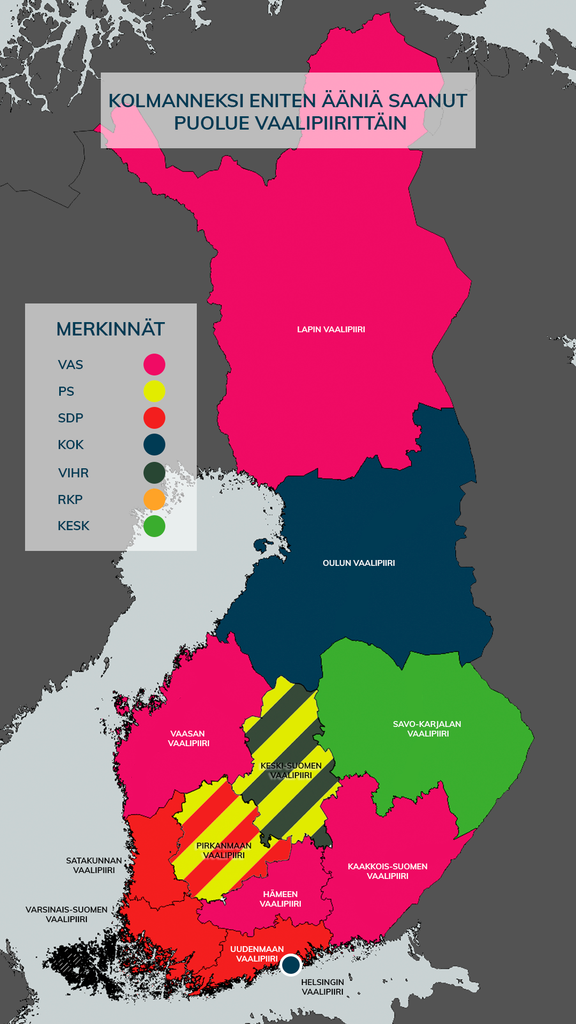
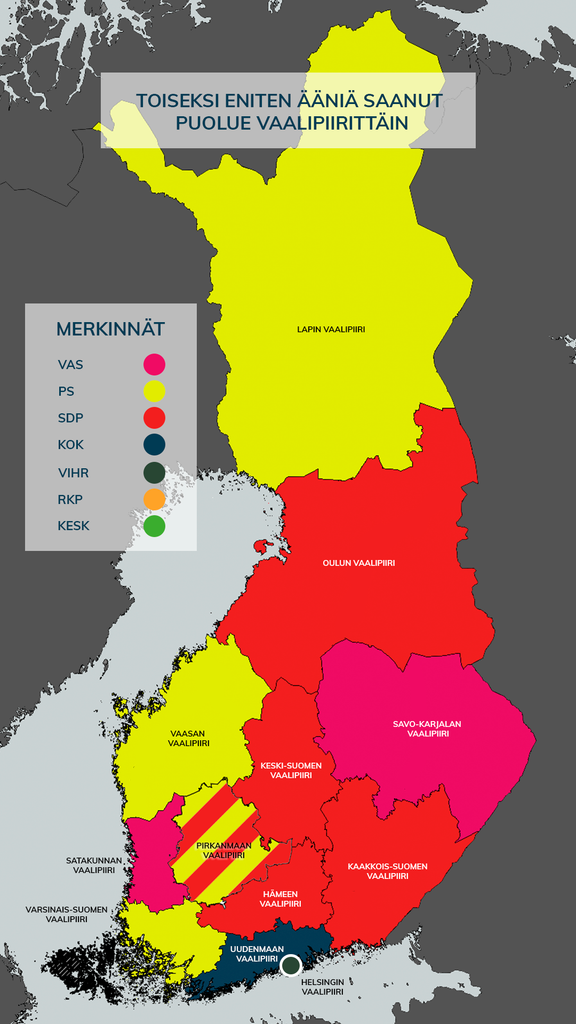
If you’re interested in seeing how young people in your area voted, you can view the election maps below. The maps show the party that received the most, second-most and third-most votes in each constituency.
Thank you to all the schools and young people who took part in the National Youth EU Elections! And to everyone turning 18, remember to vote on 9 June!

Further information:
Amanda Alvesalo, President (comments)
[email protected]
+358 50 321 6600
Anthony Fedorov, Project Coordinator (background information on organising the elections)
[email protected]