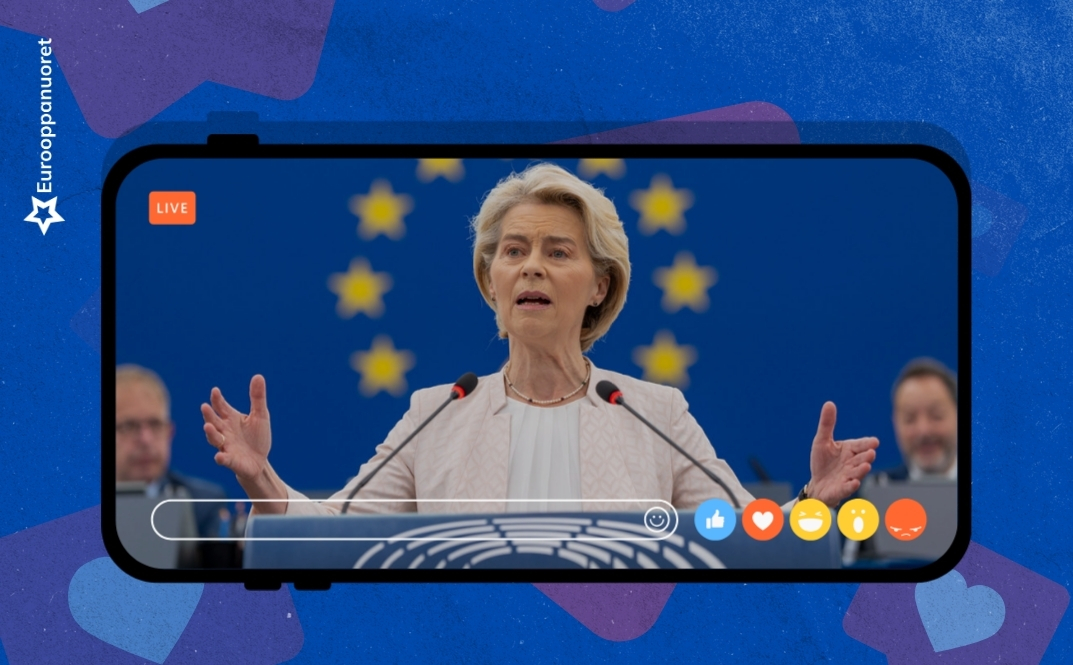
Last week, the European Commission presented its EU KIDS ACT proposal, which would ban children under 13 from using social media and impose restrictions on its use by children under 15.
JEF Finland shares concerns about the numerous harms of social media. However, we see several problems with the Commission’s proposal related to increased surveillance, the growing influence of social media giants, and the democratic rights of children and young people. JEF Finland demands that the EU address the harmful business models of these platforms for all users and involve young people in the development of policies that affect them.
The issue that the EU KIDS ACT aims to address is a valid one, and it is understandable that policymakers want to take action. Research has shown that heavy social media use is linked to increasing mental health problems, particularly among younger users. There is also widespread concern about children’s exposure to harmful content, as well as bullying, harassment, and even crimes occurring on these platforms.
The problem with the EU KIDS ACT is that the Commission chose the easiest possible solution: an age restriction that looks effective on paper but leaves the root causes unaddressed. In democracies, increasing government oversight of citizens should always be a last resort. At the same time, increased oversight would also bolster the power of tech giants. Under the proposal, responsibility for restriction mechanisms and the “safe design” of platforms lies with social media giants such as Meta and ByteDance. These companies have shown little willingness in the past to, for example, disclose their algorithms or intervene in content spreading on their platforms, so we should not place too much trust in them now either. In general, increasing oversight seems like an easy political decision made by adults without consulting minors.
Furthermore, it is unclear on what grounds content harmful to children and young people is defined and who is responsible for that definition. Social media is not merely a risk for young people. It is a place where they express themselves, seek information, follow the news, and participate in public discourse. At its worst, strict censorship limits minors’ opportunities to participate in democracy by removing their ability to communicate on social media, follow world events, and engage in political activism. In such cases, young people’s role as active citizens and influencers in decision-making is significantly diminished. Freedom of expression and the right to information are fundamental rights for everyone, not just adults.
JEF Finland calls for the well-being of children and young people to be supported through means other than age restrictions and increased monitoring. Social media platforms should be made safer for everyone, but especially for minors. This could be achieved, for example, by strengthening the enforceability of the European Digital Services Act (DSA) and the General Data Protection Regulation (GDPR), as social media giants currently comply with existing regulations to varying degrees. The Commission’s proposal includes some effective solutions that should be extended to all users. It would ban features that hook minors, recommendation feeds based on profiling, endless scrolling, and contact requests from strangers. The same mechanisms that hook a 14-year-old also drive adults toward addiction, polarization, and disinformation. If an algorithm is harmful to a child, it does not suddenly become harmless on their 18th birthday.
The EU should therefore regulate the platforms, not young people. Algorithms must be transparent, data collection must be restricted, and every user must have the power to decide what appears in their feed. Adults must also take a good look in the mirror. A large portion of online hate speech and scams is generated by adults, and setting a good example starts at home. JEF Finland demands that decision-makers and adult users take responsibility for their actions. Platforms must be required to prioritize the safety and well-being of young people over financial interests.
More information
Pieta Päivänen
President