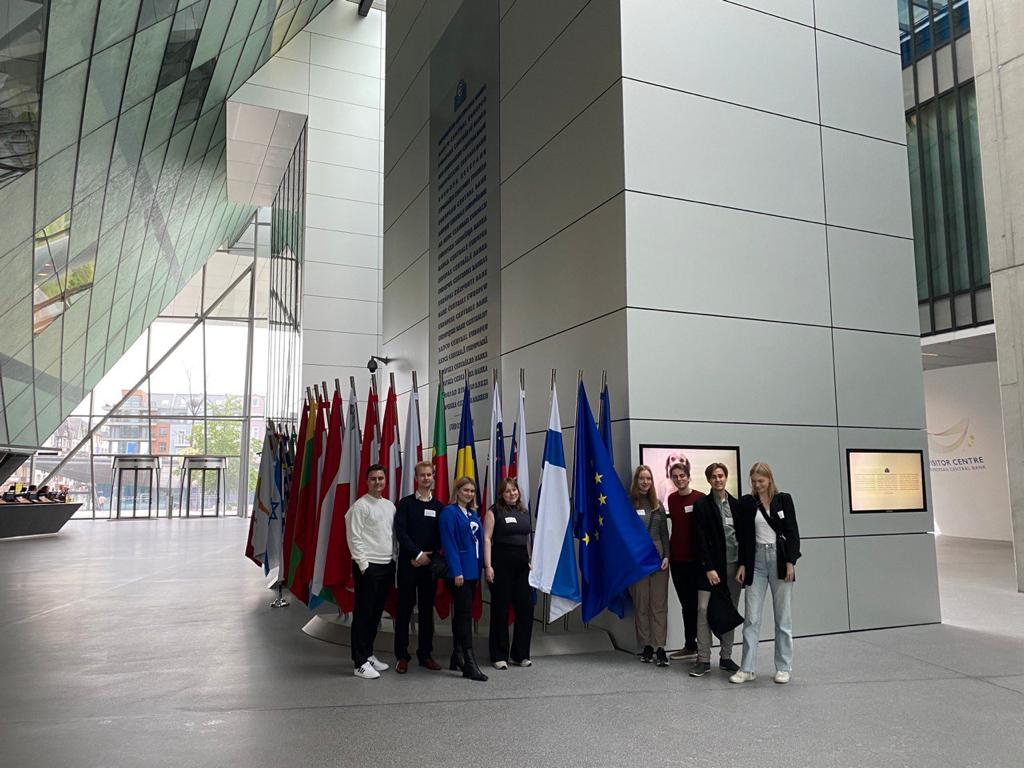
On the joint October excursion of JEF Tampere and JEF Jyväskylä, the group headed to Germany, to the city of Frankfurt am Main. The city, located in the state of Hesse, has a long history as one of the hubs of the German economy. Even today it is one of the most important centres of European business life. The city’s successful past is recalled by ornate churches reaching for the sky. Today they stand alongside glass skyscrapers housing
international banks and major corporations alike. One of the skyscrapers, however, is larger
than the others and stands slightly further from the centre, on the banks of the River Main.
The European Central Bank (ECB) is a European Union institution responsible for the
monetary policy of the euro area. The ECB has three key tasks: maintaining price stability in the euro area, i.e. the defined 2%
inflation target, supervising banks, and issuing and managing the currency. One could imagine the central bank
as a kind of air traffic control tower, from which the traffic of the world economy is constantly monitored
and its own operations coordinated accordingly. The responsibilities and
mandates granted to the ECB stem from the 1992 Maastricht Treaty, which established the European
Economic and Monetary Union (EMU). At present there are twenty euro countries in total – seven EU member states have thus remained outside the common currency.
The European Central Bank and its main operations are thus located in Germany, in the city of Frankfurt am Main,
which is one of Europe’s foremost financial hubs. Frankfurt is home to several major banks,
offices of international companies and the Frankfurt Stock Exchange. The financial centre was chosen as the location of the central bank
for roughly two reasons. Firstly, it is natural for the body overseeing banking supervision and
financial activity to be close to the banks it supervises. Secondly, at the time the ECB was founded, German soil
lacked a larger EU institution, so the principle of decentralisation was also
taken into account. The current headquarters stands further away from the banks’ skyscrapers, on the site of a former
wholesale market hall. The glass twin skyscraper, 185 metres tall, was taken into use
in 2015.
At the top of the institution and its headquarters sits the ECB’s current President, France’s Christine
Lagarde, who previously served as Managing Director of the International Monetary Fund (IMF) and as
France’s Minister of Finance. The President is appointed by the European Council and her duties
include acting as the central bank’s highest representative and chairing the Governing Council
and the Executive Board. The Governing Council comprises the governors of the national central banks of the euro countries, meaning that
through the Council the euro countries coordinate their mutual actions. At Council meetings Finland
is represented by the current Governor of the Bank of Finland, Olli Rehn. The role of the former national banks is by no
means insignificant – they could be called the ECB’s ”branch offices”, through which
monetary policy operations are carried out in the euro countries.
The most concrete ECB activity concerns the regulation of key interest rates. Through the key rate, the central bank
sets the interest level at which it lends money to banks. The banks in turn lend money onwards
to companies and households at their own rates. From the top of this hierarchy the central bank can thus
regulate the amount of loan money on the market. A high interest rate level aims to curb
overall consumption, which is traditionally thought to slow down inflation. When the economy slides into recession,
the aim is instead to stimulate consumption by lowering interest rates.
At present, the interest rate maintained by the ECB (4.25%) has been viewed rather critically, since
in addition to inflation, the euro area is overshadowed by an approaching recession. According to critics, with a high
interest rate level the ECB may cause an even deeper and longer recession. On the other hand, the debate
has also noted how the era of zero interest rates, which lasted several years, is not a natural state
for the economy. The only certainty is that stabilising the currency of an economy the size of the euro area
is no easy task – the ECB acts in a markedly reactive manner, even though its operations are also guided by certain
economic assumptions.
As an institution, the ECB is always emphasised to be an independent and politically unaffiliated actor, where
responsibilities are handled with civil-service precision. It has therefore not been considered appropriate for politicians
to comment on the actions of the independent central bank. It is worth noting, however, that
the central bank specifically implements monetary policy, to which the other sectors of politics must
adapt. Alongside the euro area’s common monetary policy, there should also be more common
coordination of economic policy – with the proviso, however, that decision-making must be democratic
and take into account the differences between the euro countries. The euro area must also be kept open to potential new
members.
Increasing the euro area’s operational readiness and competitiveness may also require reforming the central bank and,
with it, monetary policy. With broader powers, the central bank could support the euro area’s economic development with a more
active monetary policy and respond to crises.
Despite occasional criticism, Finland’s place is in the euro area. The euro is a stable and
competitive currency that enables more effective use of the single market.
For a small market area the size of Finland, the European single market is essential.
Above all, the euro has bound Finland ever more firmly into the European integration process –
that too is vital for a state of Finland’s size.
Text: Santeri Anttila
The author is TEN’s EU Affairs Officer and studies politics at Tampere University.