
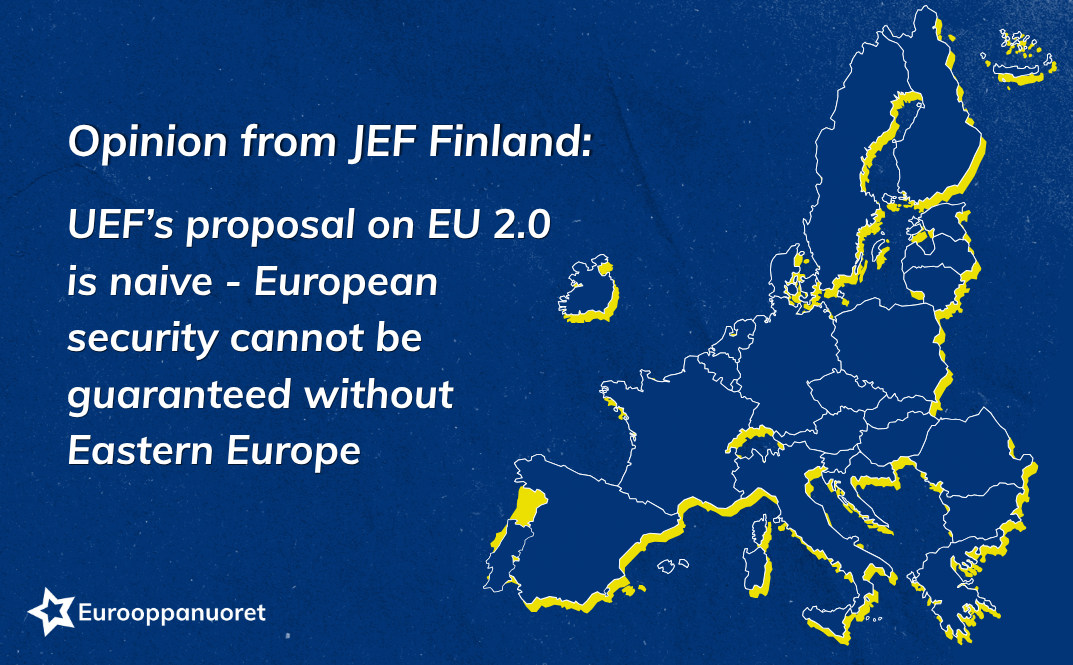
On Europe Day, May 9, 2026, the Union of European Federalists issued a statement calling for a radical reform of the EU to address the crises of the 21st century. The UEF’s proposal calls for the formation of a political core, “EU 2.0,” comprising France, Germany, Spain, Poland, and the Benelux countries.
The statement emphasizes that a “union within the union” does not imply a division, but rather an opportunity for some member states to deepen their mutual cooperation. An updated version of the proposal was published on May 14, in which the division remained the same, but the openness of the core to “unwilling states” was emphasized. JEF Finland recognizes the possible need for multi-speed integration, but demands deeper cooperation to be open to all member states. We view the UEF’s proposal as flawed and biased for unjustifiably excluding numerous member states, such as the Nordic and Baltic countries. JEF Finland demands that integration be deepened in a way that takes into account the EU’s diversity at large, not merely as a club for the biggest states.
We find it problematic that the proposal’s distinction between “core” and “member states” is not adequately justified. The idea may be that “core states” are currently governed by pro-EU governments that are prepared to commit to deeper integration. This would explain why, for example, Italy is completely excluded from the proposal. On the other hand, even the “core states” have not shown unanimity, as Poland, for example, opposes the EU migration pact and Germany has repeatedly violated the Schengen Agreement on free movement. It is unfounded to suggest that the Nordic countries, for example, would initially oppose deepening integration. On the contrary, the Nordic countries have a long tradition of supranational cooperation, and Finland and Sweden in particular are quite closely committed to the current integration, both economically and politically. Northern Europe is committed above all to supporting Ukraine in a way that has also contributed to the development of European defense cooperation. While the UEF itself calls for investments in security and a defense union, it manages to overlook the irreplaceable importance of the Nordic and Baltic countries. And above all the vision of a European federation should not be limited to the pro-European sentiments in the current electoral cycles, as this leads to failed initiatives like EU 2.0.
A periphery inevitably forms around the core. In the EU 2.0 proposal, the periphery follows almost the same Eastern borders as in Europe during the Cold War. The statement mentions the threat Russia poses to Europe, but the proposed plan would, on the contrary, weaken the EU’s geopolitical credibility. As Trump threatened Greenland, the core of the EU’s foreign policy was not located in central but in northern Europe. The UEF acknowledges that the Greenland crisis was not handled properly, but does not propose any serious corrective measures. On the contrary, EU 2.0 includes a vision in which the core would form a Security Council among themselves, which would include, for example, Spain, but not a single Nordic country.
Emphasizing the core not only downplays the current member states left outside it but also candidate countries such as Ukraine and Moldova. For Russia’s neighboring countries in particular, the placement of the core in Central Europe feels like a downplaying of a serious security threat. Throughout the 2000s, efforts have been made to level the political and economic differences between member states. The proposed core development would likely hinder this progress rather than promote it. The current Union of twenty-seven member states is a success story of enlargement, the value of which should not be forgotten.
JEF Finland shares the ideas set forth in the “European Declaration of Independence” issued by the UEF, provided that the reform of the EU takes all current and future member states into account in a balanced manner. Instead of an artificial core, the European federal project should be advanced through broad reforms that essentially affect all member states. This also means more disagreements between member states and a differentiated integration, which is an essential part of European democracy. When reforming the European Union, we must recognize and prepare for the fact that reforms often lead to differentiation, with one or more member states opting out from integration permanently or temporarily. In such cases, however, the majority of Member States remain fully committed to deeper integration. Excessive acceleration of multi-speed integration may lead to unintended fragmentation rather than deeper integration. In the history of European integration the eurozone and the Schengen Area have demonstrated how multi-speed integration must be open to succeed and should not be based on exclusionary premises. The EU must be more unified across the board, not a shadow of its past.
More information:
Pieta Päivänen, president